
Step 3 · Mix · Homogenize · Mill
FagronLab™ PM140
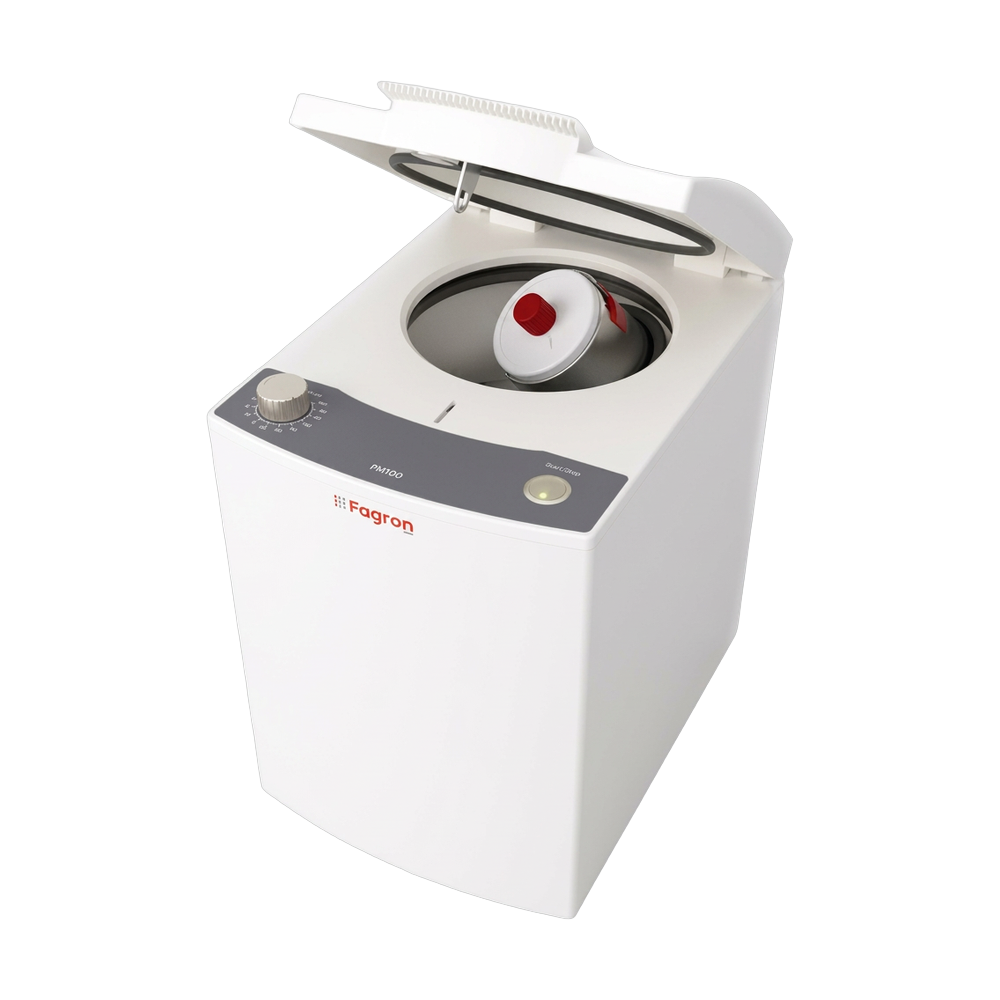
Planetary mixer
An all-in-one planetary mixer that combines mixing, deaeration and wet milling in a single step. The preparation inside the sealed FagronLab™ PM jar spins and rotates in opposite planetary motion at a 40° angle, generating centrifugal force that homogenizes the formulation without mixing blades — most formulations are finished in under 60 seconds. Because the PM jar (or MillBottle) is also the primary package, the preparation is labeled and dispensed in the same container it was mixed in.
How it is used
- Direct incorporation of liquid APIs into a base (30–60 seconds).
- Mixing after a solubility enhancer step, 30 seconds to 3 minutes depending on viscosity.
- Final deaeration of suspensions, gels and suppository masses.
- Melting and mixing for small-batch gels, gummies and suppositories with soluble APIs.
- Wet milling of whole tablets, capsules or bulk powders inside the FagronLab™ MillBottle, integrating milling, mixing and deaeration in one cycle.
- Mixing after external melting: heat the substances in a closed PM jar 125 mL HV+LV in a hot water bath (jar withstands up to 85 °C), then mix directly in the PM140.
Advantages
- Single-step process: mixing, wet milling and deaeration in one device
- Blade-free, closed-jar mixing — less cleaning, no cross-contamination
- Volume-adjustable PM jar 100 mL HV for smaller batches
- Safer handling of hazardous drugs; jars can be used in negative-pressure cabinets
- Low temperature rise, safe for thermolabile substances
- Compact, low-maintenance design that fits on a workbench or in lab furniture
Operating parameters
Source: FagronLab™ Formulation Guide. Always follow the parameters for your jar size and API concentration.
PM140 typical run times
| Process | Time |
|---|---|
| Direct incorporation of a liquid API | 30 – 60 seconds |
| Mixing after a solubility enhancer step | 30 seconds – 3 minutes (viscosity dependent) |
| Deaeration of a suspension or suppository mass | 30 – 45 seconds |
| Gel and gummy, small batches (includes melting) | around 15 minutes |
| Suppositories with soluble APIs (includes melting) | around 15 minutes |
Mixing protocol — low-viscosity bases
When a powder API is used, a levigating agent is recommended to help incorporation. Pre-mix it into a paste or place it above the powder so it is fully covered, and always check compatibility with the base.
| Formula type | Emulsion/Gel + liquid API | Emulsion/Gel + powder API |
|---|---|---|
| Jar | PM jar 125 mL HV+LV | PM jar 125 mL HV+LV |
| Quantity | 50 g – 125 g (max) | 50 g – 125 g (max) |
| Time | 30 seconds | 50 seconds |
| Temperature | Max. 25 °C | Max. 25 °C |
Mixing protocol — high-viscosity bases
High-viscosity creams such as transdermal bases (e.g. Pentravan®) require extended mixing times.
| Formula type | Pentravan® + liquid API | Pentravan® + powder API |
|---|---|---|
| Jar | PM jar 100 mL HV / 125 mL HV+LV | PM jar 100 mL HV / 125 mL HV+LV |
| Quantity | 50 g – 100 g (max) | 50 g – 100 g (max) |
| Time | 30 seconds – 1 minute | 2 – 3 minutes |
| Temperature | Max. 25 °C | Max. 25 °C |
Deaeration protocol — formulations with entrapped air
| Formula type | Emulsion/Gel + liquid API | Emulsion/Gel + powder API |
|---|---|---|
| Jar | PM jar 100 mL HV | PM jar 100 mL HV |
| Quantity | 50 g – 100 g (max) | 50 g – 100 g (max) |
| Time | 30 seconds | 45 seconds |
| Temperature | Max. 25 °C | Max. 25 °C |
Mixing protocol after external melting
For vaginal inserts, suppository bases and other gelatin or gum bases melted in a hot water bath.
| Formula type | Supposiblend™ + liquid API | Supposiblend™ + powder API |
|---|---|---|
| Jar | PM jar 125 mL HV+LV | PM jar 125 mL HV+LV |
| Quantity | 125 g (max) | 125 g (max) |
| Time | 30 seconds | 50 seconds |
| Temperature | Depends on the initial temperature | Depends on the initial temperature |
Wet milling protocol
Performed in the FagronLab™ MillBottle, which also serves as the dispensing container.
| Formula type | Suspension base + tablets/capsules | Suspension base + powder API |
|---|---|---|
| Vessel | FagronLab™ MillBottle | FagronLab™ MillBottle |
| Quantity | 150 mL (max) | 150 mL (max) |
| Time | 5 – 10 minutes | 5 – 10 minutes |
| Temperature | Max. 45 °C | Max. 45 °C |
Critical process steps standardized by the PM140
| Critical process step | Variable to monitor | Standardized? |
|---|---|---|
| Mixing / homogenization | Time, speed | Yes |
| Wet milling | Speed, friction, dispersion | Yes |
| Ingredient incorporation | Mixing method, time, speed, dose accuracy | Yes |
| Packaging | Jar/bottle closure, absence of reactions with the formulation | Yes |
What it delivers
Dosage accuracy
For volume-dependent doses such as HRT creams, deaerated mixing improves API distribution and keeps every dispensed dose consistent.
Material-loss prevention
The formulation is mixed in a disposable PM jar or MillBottle that doubles as primary packaging, so nothing is lost in transfer.
Time savings
A fixed 2,800 rpm speed prepares most formulations in less than 60 seconds, with deaeration completed in about 50 seconds.
Conservation of resources
No blades or rods to wash means no subsequent rinsing steps and reduced water use.
Mechanism of action
The preparation inside the FagronLab™ PM jar simultaneously spins and rotates around an axis in opposite planetary motion while all components are held at a 40° angle. The resulting centrifugal force drives particles toward the edges of the jar, so mixing happens in a fully enclosed environment without blades.
The operation releases heat uniformly and gradually, reaching up to 45 °C after 15 minutes when started at room temperature. That low temperature rise keeps thermolabile substances safe and helps maintain the physical state of previously melted suppository and gel bases during mixing.
Deaeration and dose accuracy
Entrapped air alters the texture, pH and density of emulsions and gels, and encourages oxidation and microbial growth. Air also changes the density of a cream, which compromises the precise dosing required for HRT preparations dispensed from calibrated packaging.
The PM140 removes macrobubbles from emulsions and gels in roughly 50 seconds, so each application delivers the intended dose.
Wet milling with the FagronLab™ MillBottle
Suspensions and colloidal solutions are prepared in one step using the patent-pending FagronLab™ MillBottle. Whole tablets, capsules, capsule contents or bulk powders are placed in the bottle with the required amount of water or suspension base and the lid is closed.
At high speed, centrifugal force crushes the medication against the strips inside the bottle, reducing particle size and dispersing it evenly through the base. The MillBottle then serves as the storage and dispensing container for the finished preparation.
Melting workflow
The PM140 has no heating element, so melting is done by applying external heat. Substances are heated directly in a closed FagronLab™ PM jar 125 mL HV+LV in a hot water bath — the jar withstands temperatures up to 85 °C — which protects the formulation from water vapor and other contaminants.
The same jar is then inserted into the PM140 for mixing, eliminating any transfer step and preventing re-solidification thanks to the gentle heat released during operation.
Hazardous drug handling
Weighing, mixing, crushing tablets, opening capsules and pouring liquids are all recognized exposure points when compounding hazardous drugs. The PM140 performs those steps in the closed environment of a PM jar or MillBottle, and the jars can be placed in negative-pressure cabinets for additional protection.
Specifications
- Mixing speed
- Fixed at 2,800 rpm
- Typical cycle time
- Under 60 seconds for most formulations
- Deaeration time
- ≈ 50 seconds for emulsions and gels
- Mixing angle
- 40° planetary motion, no mixing blades
- Heat release
- Gradual, up to 45 °C after 15 minutes from room temperature
- Maximum batch
- 125 g (PM jar 125 mL HV+LV) / 100 g (PM jar 100 mL HV)
- Accessories
- PM jar 100 mL HV, PM jar 125 mL HV+LV, FagronLab™ MillBottle
- Dosage forms
- Creams, ointments, gels, gummies, oral suspensions, suppositories, vaginal inserts, mucosal films, gelatin bases

Questions about equipment?
Contact your Fagron Equipment Representative, Nicholas Fournarakis
Nicholas can help with pricing and demonstrations for any FagronLab™ device or for workflow consultations.
Nicholas.Fournarakis@fagron.usContact Fagron
Have a Question? We’re Here to Help.
Contact our team for support with ingredients, equipment, formulations, education, ordering or other compounding needs.
Personalized support
How Can We Support You?
Tell us what you are looking for and a member of the Fagron team will connect you with the appropriate product, service or educational resource.
Email us
Responsive support
A member of our team will review your request and follow up.
Personalized guidance
Product, formulation, equipment and education support.
201 W. 5th Street, Suite 1250, Austin TX 78701