
Step 4 · Fill
FagronLab™ Suppository Molds
Multiple sizes available
Disposable molds for suppositories and vaginal inserts that double as primary packaging. Filled on the FagronLab™ 3-in-1 Support Rack and left to solidify at room temperature, they never have to be opened after solidification — removing the breakage, contamination and 10% overfill waste of traditional brass molds. Part of the FagronLab™ Suppository Solution alongside the support rack, sealing tape and single pack.
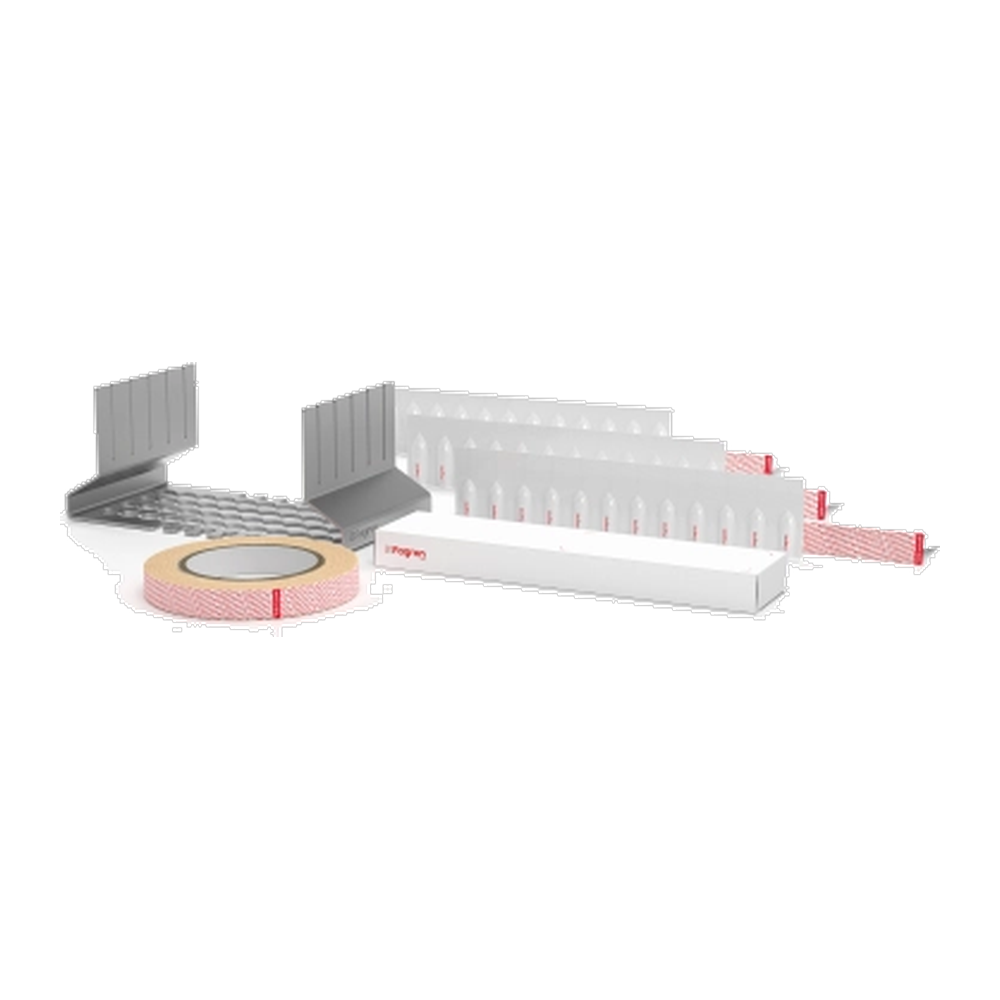
How it is used
- Filled from the PM jar after deaeration in both suppository workflows.
- Sealed with FagronLab™ Suppository Sealing Tape once solidified.
- Cells torn along marked tear lines to match the exact prescribed quantity.
- Used as the primary packaging, then inserted into the FagronLab™ Suppository Single Pack for delivery.
Advantages
- Versatile use for suppositories and vaginal inserts
- Compliance with GMP and pharmacopeias
- Safe and hygienic — no mold opening after solidification
- Time saving — no additional primary packaging step
- Organizer box with product information on the edges for quick shelf checks
- Tear-resistant cells separable to the exact prescribed quantity
- Eco-friendly paper-based sealing tape instead of aluminum foil
Operating parameters
Source: FagronLab™ Formulation Guide. Always follow the parameters for your jar size and API concentration.
FagronLab™ Suppository Solution — product line
| Product | Role |
|---|---|
| FagronLab™ 3-in-1 Support Rack | Holds suppository, insert and eyedrop molds securely in place during filling |
| FagronLab™ Suppository Mold | Disposable mold that also serves as the primary packaging |
| FagronLab™ Suppository Sealing Tape | Pre-cut paper labels that seal the mold lid against air and contamination |
| FagronLab™ Suppository Single Pack | Secondary packaging with space for labeling and application details |
Ideal packaging characteristics according to GMP
| Requirement |
|---|
| Preventing spillage, breakage and contamination |
| Damage-free transport |
| Light, temperature and moisture resistance |
| Container selection based on the requirements |
| Sufficient information on the label |
| No interaction with the compounded preparation |
What it delivers
No breakage losses
Brass molds require greasing, careful opening and an extra 10% of suppositories to cover breakage. Disposable molds remove that waste entirely.
Primary packaging in one step
The mold is the container, so the preparation is never transferred or exposed after solidification.
GMP-grade protection
The PVC/PVDC barrier resists water vapor, gases and chemicals, and the sealing tape closes the lid against air and contamination.
Patient-ready delivery
The sealed mold slides into the Suppository Single Pack, which carries the compounding label and application instructions.
Why disposable molds
Suppositories soften, melt and dissolve slightly below body temperature (around 35 °C), so both preparation and packaging determine whether quality survives to administration. Traditional brass molds must be greased with paraffin before pouring and opened with care; pouring into an ungreased mold, cooling in a fridge instead of at room temperature, or careless opening all cause breakage — which is why pharmacies routinely prepare 10% extra.
Aluminum foil wrapping tears and risks contamination, and jars require careful temperature control because exceeding 35 °C deforms the dosage form. Disposable molds that also serve as primary packaging resolve both problems and follow the USP recommendation to use disposable equipment to reduce contamination risk.
Mold, seal, pack
The workflow is three steps. Mold: pour the mixed and deaerated preparation into the mold held in the 3-in-1 Support Rack, allowing a slight overflow, and let it solidify at room temperature. Seal: remove residue from the lid and close it with the pre-cut Suppository Sealing Tape. Pack: write the labeling information on the Suppository Single Pack, fold it into a box, insert the sealed mold and deliver to the patient.
Material safety
The sealing tape is paper-based, making it eco-friendly and easy to tear away when separating individual inserts, and its adhesive complies with FDA and EU regulations for human contact. Safety analysis followed EN 1186, EN 13130, CEN/TS 14234 and CEN/TS 14235 migration test procedures.
The 3-in-1 Support Rack is made from anodized aluminum, adding a protective layer that resists corrosion, wear and scratching. Anodizing requires minimal energy and its main byproducts — aluminum hydroxide and aluminum sulfate — are recyclable.
Specifications
- Sizes
- 3 g, 2 g and 1 g
- Format
- Strips of 12 cells with marked tear lines
- Material
- PVC and PVDC-based barrier film
- Barrier
- Protects against water vapor, gases and chemicals
- Type
- Disposable — mold and primary packaging in one
- Storage
- Resealable protective bag inside an organizer box guarding against contamination and UV light
- Support rack capacity
- Up to 5 strips (10- and 12-cell), up to 60 inserts at once
- Support rack material
- Anodized aluminum — heat-resistant, autoclave-safe, dishwasher-safe
- Sealing tape
- Pre-cut paper labels matched to mold length; adhesive compliant with FDA and EU regulations

Questions about equipment?
Contact your Fagron Equipment Representative, Nicholas Fournarakis
Nicholas can help with pricing and demonstrations for any FagronLab™ device or for workflow consultations.
Nicholas.Fournarakis@fagron.usContact Fagron
Have a Question? We’re Here to Help.
Contact our team for support with ingredients, equipment, formulations, education, ordering or other compounding needs.
Personalized support
How Can We Support You?
Tell us what you are looking for and a member of the Fagron team will connect you with the appropriate product, service or educational resource.
Email us
Responsive support
A member of our team will review your request and follow up.
Personalized guidance
Product, formulation, equipment and education support.
201 W. 5th Street, Suite 1250, Austin TX 78701